
AI Interviewers are no longer experimental tools. They are quietly becoming part of mainstream hiring workflows, especially in first-round screening.
But with adoption comes curiosity.
Not fear. Not resistance. Curiosity.
Candidates wonder how these systems work. Recruiters wonder how reliable they are. Leadership wonders whether automation strengthens or weakens hiring integrity. And one question consistently surfaces beneath the surface: What really happens during an AI interview — and how does it maintain fairness? This blog explores that question with clarity.
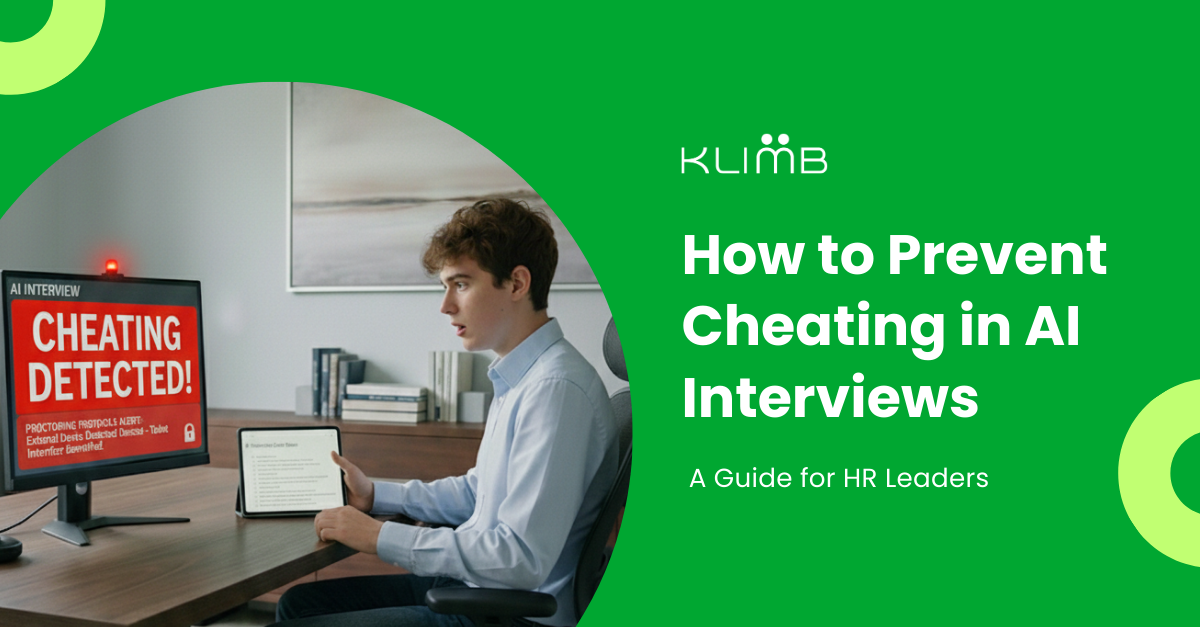
AI Interviews Didn’t Create Cheating, They Made It Visible
Let’s start with an uncomfortable truth. Cheating in interviews is not new.
Candidates have always:
- Used notes during phone screenings
- Rehearsed scripted answers
- Sought help during remote interviews
- Looked up answers mid-conversation
The difference is not behavior. The difference is visibility. Traditional interviews rely heavily on memory and intuition. AI interviews, by contrast, are structured and recorded. That structure creates traceability. And traceability creates awareness.
“When an interview is standardized, patterns become easier to observe. That’s not surveillance. That’s consistency.”
What Actually Happens During an AI Interview
To understand the integrity layer, it’s important to understand the experience itself.
In a modern AI-led interview, a candidate receives a structured link. Before starting, they typically test their camera and microphone. Clear instructions guide them through the process, and in some systems, a mock interview allows them to familiarize themselves with the format.
Questions are presented one at a time. Responses are recorded in a forward-only flow. There is no backtracking to refine answers. The structure ensures that each candidate receives the same evaluation environment. This uniformity is important. When everyone answers under the same conditions, comparisons become more meaningful. But structured interviews also reveal behavioral patterns and that’s where curiosity often begins.
Subtle Behaviors HR Leaders Should Be Aware Of
Most candidates approach AI interviews sincerely. However, in remote environments, certain behaviors occasionally emerge across industries.
A candidate may repeatedly shift their gaze away from the screen. In some cases, browser activity changes mid-response. Occasionally, face visibility fluctuates during answers. In rare scenarios, additional individuals appear in the background. None of these automatically imply misconduct. But they are signals. And signals are valuable because they provide context.
For HR leaders, the objective is not to assume the worst. It is to ensure that the screening layer does not unintentionally reward candidates who are better at manipulating digital environments. Fair hiring protects both the company and the genuinely qualified candidate.
Why This Matters More Than It Appears
At first glance, these behaviors may seem minor. But in high-volume hiring environments, small distortions compound quickly.
If even a small percentage of candidates receive unfair advantage during screening:
- Shortlists may become skewed
- Interviewer time gets wasted in later rounds
- Hiring quality may suffer
- Confidence in the system weakens
Hiring is a compounding function. Early-stage quality determines downstream success. That is why modern AI interviewers are designed not just to collect responses, but to surface contextual signals that support recruiter judgment.
What This Means for HR Leaders
As an HR leader, your responsibility extends beyond filling open roles. You are safeguarding the integrity of the hiring process itself.
An AI interview system should strengthen:
- Consistency in questioning
- Transparency in evaluation
- Reviewability of decisions
- Audit readiness
- Trust across stakeholders
When done thoughtfully, AI interviews reduce subjectivity in early rounds while increasing accountability. They create a record. They create comparability. They create clarity. That clarity builds internal trust — from recruiters to business leaders to executives.
The CEO’s Perspective: Hiring as Risk Management
From a leadership standpoint, hiring is a strategic investment decision.
A compromised screening layer increases the probability of mis-hire. Mis-hires impact productivity, team morale, and financial performance. They also erode confidence in talent acquisition processes.
AI interviews, when designed responsibly, provide structured guardrails. They create consistency in early evaluation and ensure that human decision-makers have more context, not less. This is not about automation for speed alone. It is about structured governance in hiring.
The Larger Shift in Modern Hiring
AI interviews represent a broader shift toward structured screening. They do not eliminate human interaction. Instead, they protect it.
By automating repetitive screening layers, recruiters gain time to focus on meaningful conversations. By surfacing behavioral signals, systems protect fairness without removing judgment. The goal is not technological dominance. It is hiring discipline.
Where Klimb Aligns with This Philosophy
Everything discussed above — structured first-round screening, multilingual support, behavioral signal visibility, and human-led final decisions — reflects the approach taken by Klimb’s AI Interviewer.
But the larger principle matters more than the product itself:
AI in hiring must enhance integrity, not replace accountability. When built thoughtfully, it does exactly that.
Want to Understand How an AI Interviewer Actually Works?
If you’d like a deep breakdown of how AI Interviewers function, from JD parsing and question generation to evaluation logic and rollout strategy then read our complete guide:
AI Interviewer 101: The Full Guide to Getting It Right
It covers how AI interviewers work, what to look for, common concerns, and how to implement them effectively.