
The Hiring Challenge
A leading EdTech organization recently explored a different approach to hiring for inside sales roles.
The challenge was familiar — high candidate volumes, repetitive first-round interviews, and increasing dependency on hiring managers for early-stage evaluation. The objective was not just to improve hiring speed, but to understand whether the first round could become more structured and reliable without compromising hiring quality.
About the Hiring Requirement
The trial focused on telesales junior and fresher roles.
Candidates were graduates from Tier 1 cities and interviews were conducted in English. The evaluation setup was managed in-office, where candidates completed AI-led interviews on laptops in a semi-proctored environment.
The process combined a voice-based AI Interviewer with structured video responses.
Candidates were evaluated on:
- Communication
- Persuasion
- Objection Handling
- Sales Readiness
- Role Motivation
Dynamic scenario-based questions were also included to assess practical decision-making during conversations.
How the Process Was Conducted
Klimb’s AI Interviewer was used as the first layer of evaluation.
A total of 61 candidates completed the interview process through the platform. Every candidate went through the same interview structure, evaluation depth, and scoring framework to maintain consistency across the entire pool.
Once completed, shortlisted candidates were presented to the hiring managers for further review.
What Emerged from the Trial
The most important outcome was the alignment between AI evaluation and hiring manager expectations.
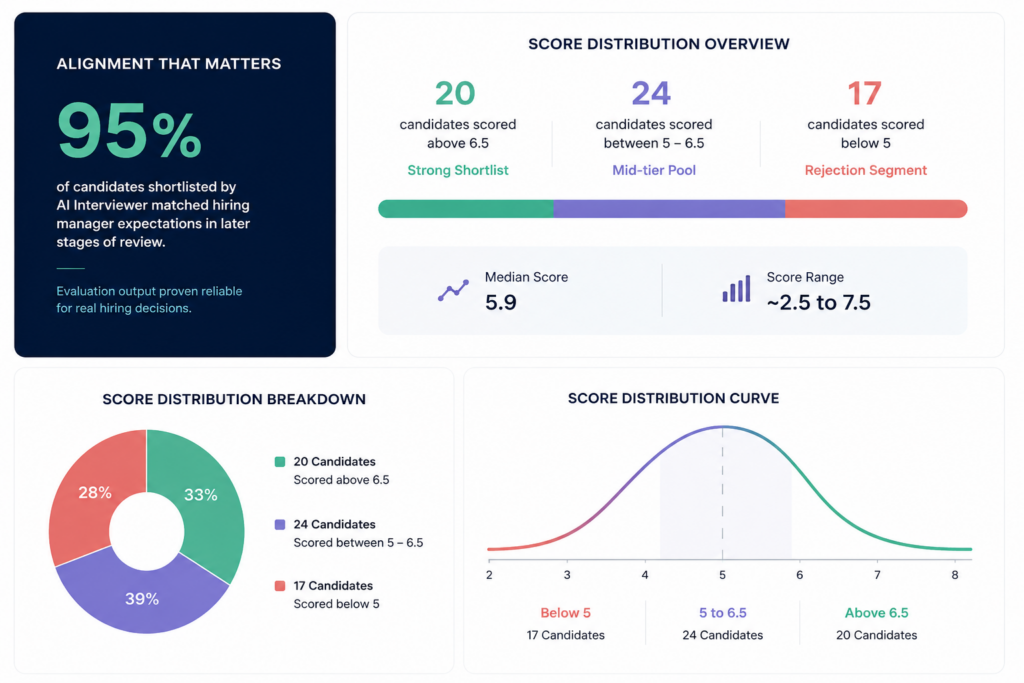
In 95% of cases, the candidates shortlisted through the AI Interviewer matched the expectations of the hiring managers in later stages of review.
This demonstrated that the evaluation output was not only structured, but also reliable enough to support real hiring decisions.
The scoring distribution further reinforced this:
20 candidates scored above 6.5 and formed a strong shortlist.
24 candidates fell within the 5 to 6.5 range, creating a viable mid-tier pool.
17 candidates scored below 5, forming a clearly identifiable rejection segment.
The median score remained balanced at 5.9, helping create a usable and interpretable evaluation spread without inflated scoring.
Why This Matters
The challenge in early-stage hiring is not only managing volume. It is ensuring consistency and confidence in evaluation quality.
By standardizing the interview structure and assessment framework, the AI Interviewer created a more comparable and scalable first-round evaluation process that was less dependent on individual interviewer judgment.
Instead of spending time on repetitive screening conversations, hiring managers could focus directly on evaluating relevant candidates.
Experience the Interview
See how Klimb’s AI Interviewer conducts candidate interactions in both English and Hindi through the sample interview conversations below.
Moving Forward
As hiring demand continues to increase, the need for structured and reliable first-round evaluations becomes more critical.
AI Interviewer by Klimb helps hiring teams create a more consistent and decision-focused hiring process.
Book a demo to explore how AI Interviewer can fit into your hiring workflow.